Oxygen is the most abundant element on the earth’s surface and as a gas is indispensable in respiration. Composing almost 21% of the atmosphere, oxygen is a colorless, odorless and tasteless gas which supports combustion. As a liquid at -297°F, oxygen is light blue in color and is approximately 14% heavier than water. Liquid oxygen is classified as a Type II by the Compressed Gas Association (CGA). CGA Pamphlet G-4.3, Type II, Grade B and the United States Pharmacopia (USP) specs are considered standards for commercial liquid oxygen.
Features
- Colorless, odorless and tasteless gas
- Highly oxidizing gas
- Vigorously supports combustion of many materials
- Widely used with a fuel gas for cutting, welding, brazing and soldering. Oxygen is also used as the plasma cutting gas on carbon steel
- The use of oxygen gives higher flame temperatures than if air is used
Specifications
Cylinder
- Connection Valve (CGA) : CGA 540
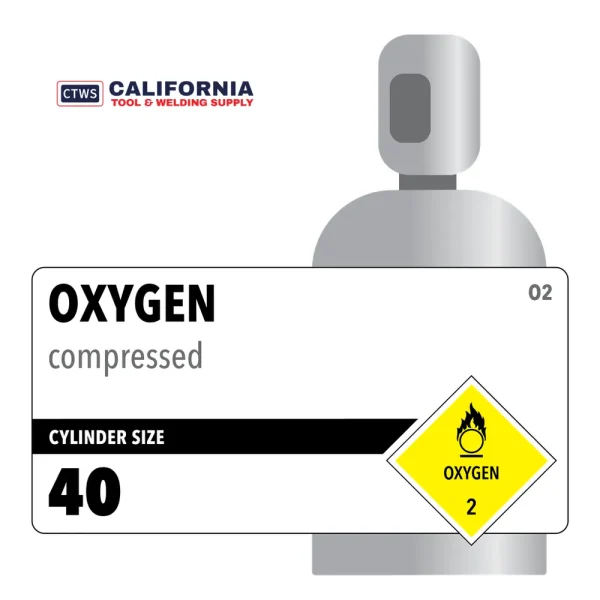
- Cylinder Size : 40
- Cylinder Volume (lbs, l, or ft3) : 40 ft3
- Cylinder Material : Varied
Technical
- Gas : Oxygen
- Symbol : O2
- Chemical Symbol : O2
- Gas Grade : Industrial
- Molecular Mass : 32 g/mol
- Specific Volume : 12.1 ft3/lb (0.76 m3/kg)
- CAS Number : 7782-44-7
Shipping
- Shipping Name : Oxygen, Compressed
- Hazard Class : 2.2 (5.1)
- UN Number : 1072
- Label : Nonflammable Gas, Oxidizer
Safety
- Physical state : Gas
- Appearance : Colorless gas
- Color : Colorless
- Odor : No odor warning properties
- Melting point : -219 °C (-362°F)
- Boiling point : -183 °C (-297°F)
- Critical temperature : -118.6 °C (-181.48°F)
- Critical pressure : 50.4 bar (731.4 psia)
- Relative vapor density at 20 °C : 0.0827 lb/ft3 (1.325 kg/m3) absolute vapor density at 70°F/21.1°C, 1 atm
- Relative vapor density at 20 °C : 1.1
- Density : 1.4289 kg/m_ (at 21.1 °C)
- Relative gas density : 1.1
- Solubility : Water: 39 mg/l
- Oxidizing properties : Oxidizer