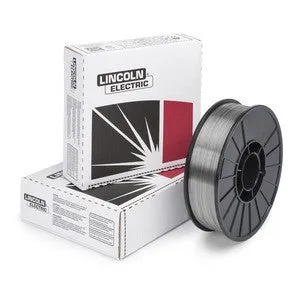
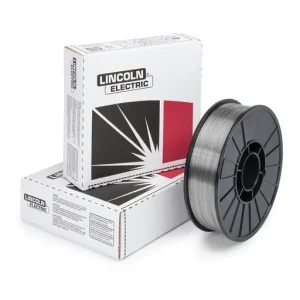
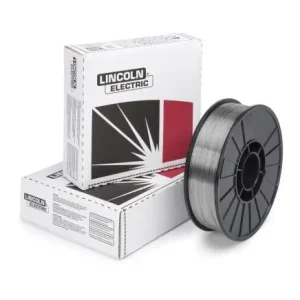
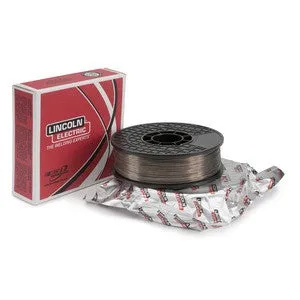
This is what makes it usable outdoors where wind would blow away MIG shielding gas, and it is why flux-cored wire is the standard for field work, structural steel and heavy fabrication.
Two families exist. Self-shielded (FCAW-S) wire needs no external gas at all and tolerates wind and outdoor conditions. Gas-shielded (FCAW-G, sometimes called dual-shield) wire uses CO2 or a CO2 mix for better arc stability, deeper penetration and better mechanical properties, but must be used indoors or with wind protection.
Classification follows the same logic as stick electrodes: E70T-1 and E71T-1 are 70 ksi flux-cored wires, with the suffix describing position capability and shielding. The -1 types are generally all-position; -2 types are flat and horizontal only with higher deposition. The -9 and -11 suffixes indicate self-shielded wires with different toughness characteristics.
Polarity and gas requirements are not interchangeable. Many self-shielded wires run DC electrode negative, which requires the machine to be set accordingly; running them on the wrong polarity produces poor arc characteristics and porosity.